

Traditional marketing for small business is more powerful than most owners realize. When most small-business owners think ‘marketing,’ they picture a Facebook ad or an email blast — yet the same local coffee shop, boutique, or service company has probably already spent on a billboard, a radio spot, a TV commercial, or a community newspaper.
Below you’ll find:
| Benefit | Why It Works |
|---|---|
| Local relevance | 55 % of adults still browse print and listen to local radio while commuting. |
| High recall | Nielsen reports 32 % of consumers bought something after seeing a billboard; 27 % cited a newspaper ad. |
| Complementary reach | Traditional media captures audiences that may not be online 24/7. |
These facts show that traditional marketing strategies can still deliver real ROI—if you capture the right data.
Before we get too much further, let’s introduce one key acronym: OOH. OOH stands for “Out-of-Home”, and represents the traditional marketing for people who are, well, not at home. That includes billboards, the poster ads by bus stops, and can be digital signage as well as print.
Think of each campaign as a single row in a spreadsheet. Capture these columns and you’ll have the traditional marketing data you need to compare media later.
| Data Point | Why It Matters | How to Capture |
|---|---|---|
| Medium | Billboard, radio, TV, newspaper, etc. | Text entry |
| Date | Chronology for time‑series analysis | Date picker or mm/dd/yyyy |
| Time | Aligns with digital traffic spikes (radio/TV) | hh:mm AM/PM |
| Location / Station | Pinpoints exposure area | Text entry (e.g., “Downtown 5th Ave.” or “WXYZ 101.5 FM”) |
| Impressions / Readership | Raw exposure estimate (if provided) | Number entry (e.g., 120,000 for a billboard) |
| Estimated Reach | Unique audience estimate | Number entry or “—” if unknown |
| Notes | Promo code, cost, ad run length, etc. | Free‑text |
Pro tip: Store the original media kit or contract in the Notes column—essential for later verification.
Not every traditional marketing channel fits every business. A plumber who serves a 10-mile radius has different needs than a boutique retailer or a regional service franchise. Here’s a practical look at what each channel does well, where it falls short, and the type of SMB most likely to get a strong return.
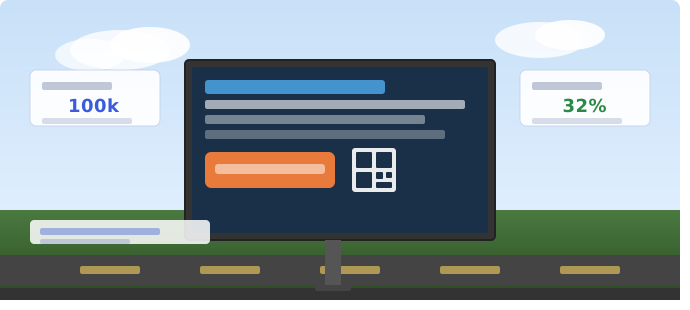
OOH is the highest-visibility option in traditional marketing for small business — your message is impossible to skip and works around the clock. It’s ideal for businesses that rely on location awareness: restaurants, retailers, auto services, and anyone trying to build brand recognition in a defined geographic area. The tradeoff is that your message must be short (seven words or fewer is the industry rule), and you get no targeting beyond geography. Use a QR code or unique promo code to make it measurable.
Best for: location-based businesses, grand openings, brand awareness campaigns. Budget range: $300–$2,500/month depending on market size and placement.
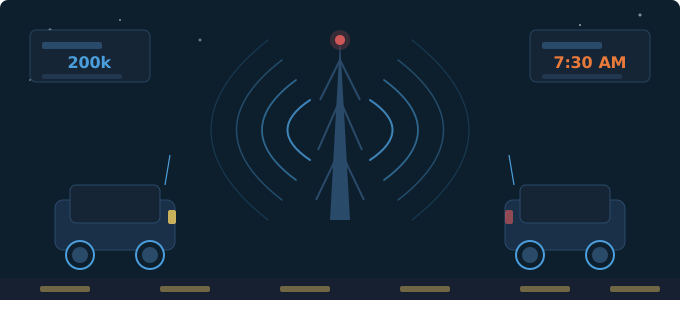
Radio delivers your message to a captive audience — commuters who can’t scroll past you. Local radio stations typically have loyal, defined audiences, which means you can target by geography, time of day, and even listener demographics. A well-written 30-second spot read by a familiar local voice carries more trust than most digital ads. The weakness is that radio is audio-only, so your offer needs to be simple and your call to action memorable — a phone number or short URL that sticks.
Best for: service businesses, event promotions, seasonal campaigns, businesses targeting commuters. Budget range: $200–$1,000/week for a local market.
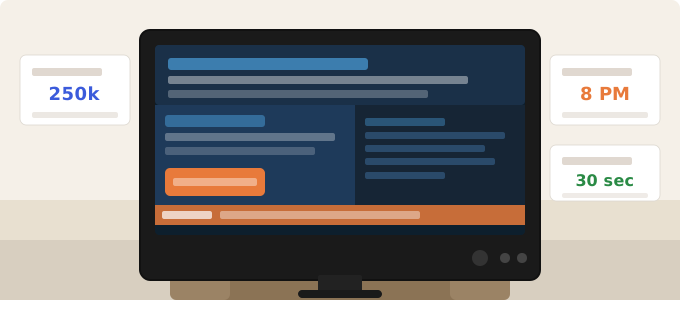
A local TV commercial does something no other channel can: it signals that your business is established. Even a modest cable spot gives SMBs a credibility boost that takes months to build through digital channels alone. TV reaches broad audiences and allows you to show your product, your team, and your personality. The challenge is cost and production — a 30-second spot requires a script, visuals, and airtime. Start with local cable rather than broadcast to keep costs manageable and targeting tighter.
Best for: businesses ready to scale, those selling visually compelling products or services, franchises. Budget range: $500–$5,000/month for local cable; more for broadcast.

Print has a loyal readership that skews toward homeowners, established community members, and local decision-makers — exactly the customer base many SMBs want. A display ad in a community newspaper or local magazine sits next to editorial content readers trust, which lends credibility by association. Print also has a longer shelf life than any digital ad: a newspaper sits on a kitchen table, a magazine in a waiting room. The limitation is lead time — you typically need to submit creative 1–2 weeks before publication.
Best for: professional services, home services, healthcare, businesses targeting 35+ demographics. Budget range: $150–$800 per insertion depending on size and publication.
Below is a copy‑paste CSV you can drop into Google Sheets or Excel. It pre‑populates formulas for impressions, reach, and cost per response so you’ll have a ready‑to‑use dashboard.
Medium,Date,Time,Location / Station,Impressions / Readership,Estimated Reach,Notes
Billboard,05/01/2026,—,Downtown 5th Ave,100000,10000,$1,200; 30‑day run
Radio,05/02/2026,07:30 AM,WXYZ 101.5 FM,200000,18000,$300; “Sunday Drive‑Thru”
TV,05/03/2026,08:00 PM,Channel 7 Local,250000,20000,$2,000; 30‑sec spot
Newspaper,05/04/2026,—,City Herald,80000,8000,$150; print + digital
Open the file, add a Cost per Response (CPR) column:
= (Cost in Notes) / (Number of responses you log)
Save as Traditional‑Marketing‑Tracker.xlsx and share it with your marketing or analytics team (or share it on your OMC account!).
Use QR codes, unique promo codes, and call‑tracking numbers to funnel traffic to Google Analytics or your GA dashboard. That way you can see exactly which traditional marketing channel drove a session, which page they visited, and whether they converted.
When you combine these touchpoints, you create a full‑funnel view that tells you how offline marketing channels work hand‑in‑hand with your digital strategy.